GWEN IFILL:
It's a mind-boggling concept: Our cosmos expanded from almost nothing to its first huge growth spurt in just a trillionth of a trillionth of a trillionth of a second. And that was after the Big Bang.
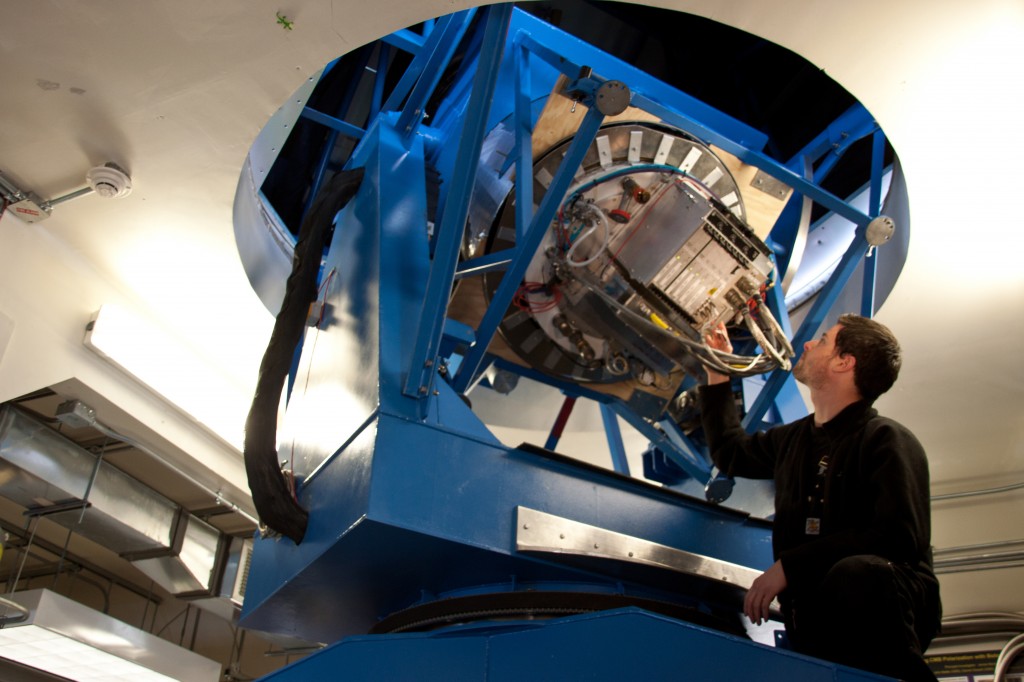
Scientists said they confirmed that theory by using this telescope at the South Pole to look at the oldest light detectable. The light reveals patterns and skewed light waves, shown here in red and blue, that were created by gravitational ripples during the — this incredible expansion known as cosmic inflation.
Sean Carroll is a physicist, cosmologist and author at the California Institute of Technology, and he joins us now to explain all of this.
And we need your explanation. Start by explaining cosmic inflation. What a term.
SEAN CARROLL, California Institute of Technology: Well, it is.
The term cosmic inflation was coined around 1980, when the ordinary economic inflation was also very much in the news. And it was Alan Guth, who was a young physicist at the time, who came up with the idea that we need to explain certain very basic features of the universe.
For example, it looks similar, it looks smooth all over the place. And so, if in the very earliest moments, the universe went through some enormously fast, super-accelerated expansion, it's like pulling at the edges of a sheet, and that expansion would actually smooth things out.
ncG1vNJzZmivp6x7sa7SZ6arn1%2Bjsri%2Fx6isq2ejnby4e8SvoJ2dnpiybq%2FOrKSim12eu6e4wK2gqKZdmsWxrc2dqmatnp7Dpr7SnmSuppSav7TAwKeboqaX